
A/B Testing Hashtags: A Step‑by‑Step Plan to Identify Winning Sets
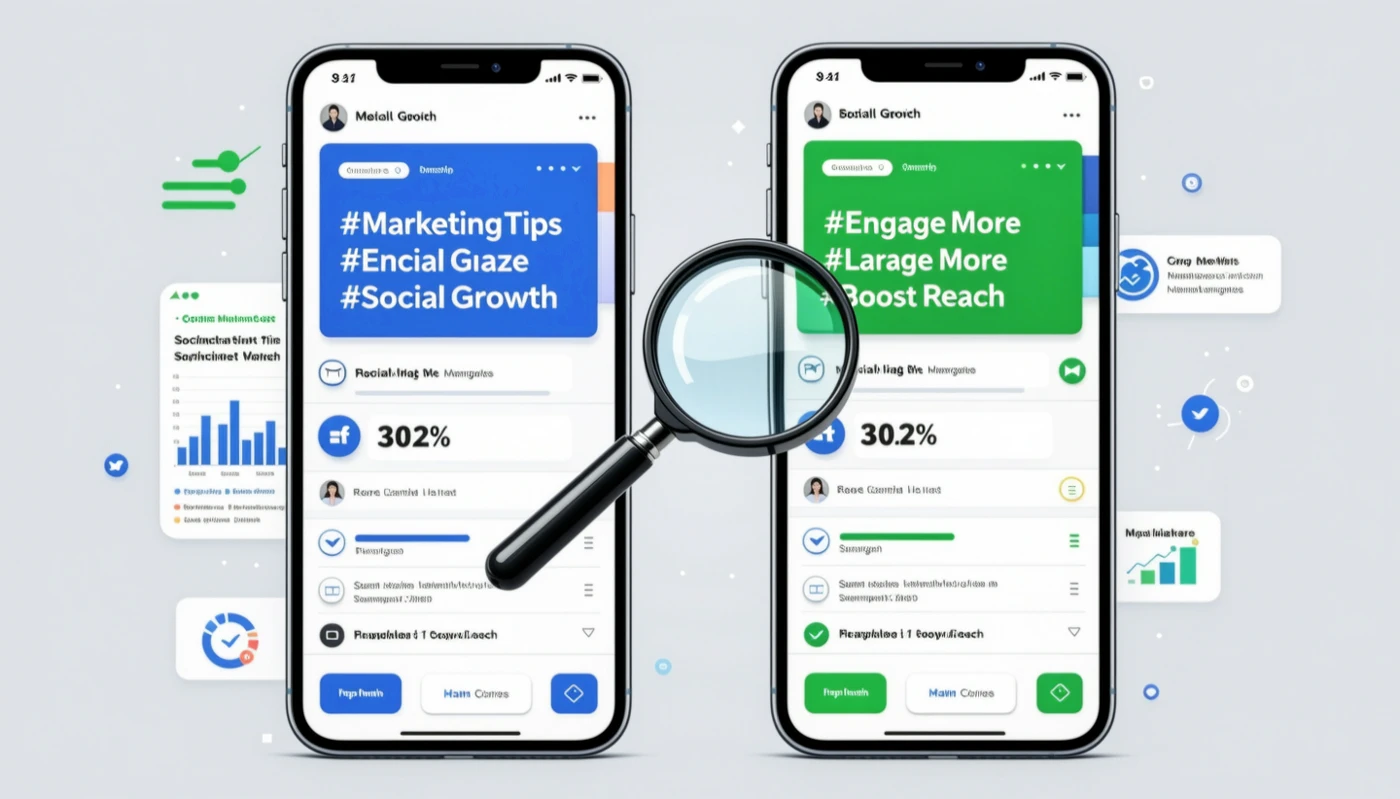
Table of Contents
A/B Testing Hashtags: A Step‑by‑Step Plan to Identify Winning Sets explains how to design, run, and interpret hashtag experiments that improve reach, engagement, and conversions across platforms. This practical guide blends experimental design, analytics, and platform tactics to get reproducible results.
What A/B testing hashtags means and why it works
A/B testing hashtags means comparing two or more hashtag sets to see which drives better outcomes like reach, engagement, or clicks. It uses controlled experiments and metrics to replace guesswork with data-driven choices.
Definition and core idea:
-
A/B test (split test): Randomly expose audience segments to different variants (here, hashtag sets) and compare performance.
-
Goal: Find a statistically meaningful lift in the metric that matters—impressions, engagement rate, saves, profile visits, or conversions.
Why A/B testing hashtags matters for modern marketers
Hashtag tests reveal marginal gains that compound across posts and campaigns, improving organic reach and ad efficiency. Small improvements in engagement often scale into meaningful business value.
Key benefits:
Improves discovery: Better hashtags increase exposure to relevant users and communities.
Reduces guesswork: Data shows what works for your audience rather than relying on generic advice.
Optimizes content strategy: Use winning sets to guide content planning and paid targeting.
-
Supports cross-platform learning: Insights on phrasing, niche tags, and branded tags transfer between channels.
Evidence & research context: Controlled experiments are the foundation of reliable optimization; design-of-experiments literature shows how structured testing prevents bias and false positives (NIST experimental design handbook). For sample-size and power calculations, consult university statistical resources to avoid underpowered tests (NIST Design of Experiments, UCLA IDRE sample size guidance).
Core metrics to test and how to prioritize them
Select one primary metric per experiment and two secondary metrics; this reduces false positives and keeps tests actionable. Primary metrics depend on your objective: awareness, engagement, or conversion.
Common metric sets by objective:
Awareness: Impressions, reach, follower growth
Engagement: Engagement rate (likes+comments+saves)/impressions, comments, shares
Conversion: Click-through rate (CTR), link clicks, form submissions, purchases
Secondary metrics provide context and help explain why a variant won:
Time-on-profile or time-viewed (video platforms)
Audience quality: bounce rate on landing pages, conversion rate
Demographics and traffic source breakdowns
Keep tests focused: choose a single primary KPI and state a success threshold (e.g., 10% relative lift) before testing.
How to design an A/B hashtag test: setup, hypotheses, and sample size
Proper design prevents bias: define your hypothesis, randomize exposure, control variables, and calculate needed sample size. A clear plan makes results reliable and repeatable.
Design steps (overview):
Define objective and primary metric.
Formulate hypothesis (directional and measurable).
Choose control and variant hashtag sets (A and B; optionally more variants).
Decide the test unit (post-level, story-level, audience segment) and duration.
Calculate sample size or required impressions for statistical power.
Crafting testable hashtag hypotheses
Make hypotheses specific and measurable. Examples:
"Adding five niche hashtags will increase saves by 12% versus our standard set."
"Replacing a branded tag with a topical tag drives 8% more profile visits."
Calculating sample size and duration
Adequate sample size avoids false positives. Use baseline conversion rates and desired minimum detectable effect (MDE) to compute required impressions.
Practical rules of thumb:
High-volume accounts: aim for several thousand impressions per variant.
-
Low-volume accounts: consider multi-week tests or aggregate multiple posts to reach sample requirements.
For rigorous calculations and power analysis use statistical guidance like UCLA IDRE and NIST resources to set sample targets before you test (UCLA sample size guidance, NIST experimental design).
Selecting hashtag sets: framework and examples
Build hashtag sets using a repeatable framework: intent, competition, specificity, and community. Balanced sets mix reach and niche tags for discovery and relevance.
Hashtag selection factors:
Intent: search vs. community (informational tags vs. community tags)
Competition level: ultra-popular vs. mid-tail vs. niche
Relevance to content: topical and audience fit
Branded and campaign tags: include to track campaign-level lift
Example hashtag set types
Reach set: 2 ultra-popular + 3 mid-tail + 2 branded
Niche/community set: 6+ niche tags that target micro-communities
Intent-driven set: mix of search queries and use-case tags (e.g., "howto", "recipe")
Build at least two distinct sets that differ meaningfully—don't test two near-identical mixes. Document each tag and why you included it.
Platform differences: how Instagram, TikTok, and X treat hashtags
Each platform uses hashtags differently—visibility algorithms, recommended tags, and user behavior vary—so tailor your experiments to platform norms and constraints.
Comparison: Hashtag behaviors across platforms |
|||
Platform |
Primary role of hashtags |
Max tags / best practice |
Algorithm notes |
|---|---|---|---|
Discovery (search, Explore, hashtag pages) |
Up to 30 tags; 3–10 targeted is common |
Combines interest, engagement, and recency; captions and comments can host tags |
|
TikTok |
Content categorization, trends, and challenges |
No strict public cap, but concise relevant tags recommended |
Strong emphasis on user interaction and trends; niche tags can surface videos in communities |
X (Twitter) |
Topic tagging and participation in conversations |
1–2 tags recommended for clarity |
Too many tags can reduce engagement; topical tags help trending discovery |
Use the table to plan platform-specific hypotheses and ensure you control for budgeted ad spend or posting cadence that could confound results.
Running the test: randomization, cadence, and execution checklist
Run tests with consistent creative and posting cadence, and randomize exposure where possible. Control variables tightly to isolate hashtag impact.
Execution checklist:
Freeze creative: use the same image/video and caption except for hashtags.
Randomize posting times or rotate variants across similar timeslots.
Post equal numbers of A and B variants or split an audience when running ads.
Log all metadata: time, caption, tag set, impressions, and secondary metrics.
Keep the test running until you reach your pre-calculated sample size.
Guides for different testing units
Post-level testing: publish paired posts with identical creative but different hashtag sets.
Ad-level split testing: use platform A/B features to split traffic cleanly.
Audience split: for large followings, use pinned posts or stories targeted to specific segments.
Analyzing results and determining winners
Compare the pre-defined primary metric between variants and use statistical tests to confirm significance; visualize trends and segment results to explain why a winner emerged.
Analysis steps:
Aggregate results by variant and compute rates (e.g., engagement per impression).
-
Run a statistical test appropriate to your metric (chi-square for counts, t-test for means, proportion z-test for rates).
Check secondary metrics and audience splits to validate the result.
Calculate confidence intervals and p-values; report effect size and practical significance.
Practical interpretation rules:
Small lifts (<5%) may be noise unless you have very large samples.
Look for consistency across multiple posts before declaring a strategy change.
Document the winning set, effect size, and test context for future replication.
Tip: If you lack statistical tools, use online A/B test calculators or built-in analytics dashboards, but always compare raw rates and consider sample size before making decisions.
Tools and workflows for scalable hashtag experiments
Automation, tracking, and a repeatable workflow speed up testing and make results reliable. Use platform analytics, spreadsheets, and experiment-tracking tools to scale.
Suggested toolstack:
Platform analytics: native insights on Instagram, TikTok Pro, X Analytics
Third-party social analytics: Sprout Social, Hootsuite, or Brandwatch for cross-platform aggregation
-
Experiment tracking: Google Sheets or a lightweight A/B test log with columns for variant, date, impressions, KPI
Stat tools: Excel, Google Data Studio, or R/Python for rigorous analysis
UTM parameters and landing page tracking: for conversion-oriented tests
Workflow template (repeatable):
Plan test: objective, hypothesis, sets, duration, required impressions.
Execute posts/ads per checklist.
Collect and clean data daily; flag anomalies.
Analyze at pre-specified end; document and act on winner.
🚀 Automate your hashtag A/B testing and scale your wins with data-driven insights from Pulzzy's AI-powered platform.
Common pitfalls and how to avoid them
Many failed tests stem from poor controls, small sample sizes, or confounding variables. Avoid these traps with clear planning and disciplined execution.
Top pitfalls and fixes:
Confounded creative changes — Fix: change only hashtags between variants.
Insufficient sample size — Fix: compute required impressions and extend duration if needed.
-
Platform algorithm interference (e.g., trend boosts) — Fix: avoid testing during unpredictable events or trending surges.
Cherry-picking winners — Fix: predefine success criteria and stick to them.
Overfitting to one post — Fix: replicate tests across several posts before systematizing.
😊 "We doubled our niche reach after three two-week tests — the structured approach removed guesswork and gave solid, repeatable results." — Community marketer
Sample test scenarios and expected outcomes
Use these ready-made test scenarios to begin: awareness-focused, engagement-focused, and conversion-focused experiments. Each includes setup, metrics, and decision rules.
Scenario A: Awareness boost for new account
Objective: increase impressions and followers
Primary metric: impressions per post; secondary: follower growth
Design: two sets — Reach (popular tags) vs. Niche (micro-community tags)
Decision rule: choose variant that increases impressions by ≥15% with p<0.05
Scenario B: Engagement increase for product posts
Objective: increase saves and comments
Primary metric: engagement rate; secondary: saves
Design: Standard set vs. Intent-driven set (howto/usecase tags)
Decision rule: select variant with ≥10% engagement lift replicated over 3 posts
Scenario C: Conversion lift using UTM-tagged links
Objective: increase landing page conversions
Primary metric: conversion rate from link clicks
Design: Branded+Niche hashtags vs. Trending+Generic hashtags; track via UTM
Decision rule: choose variant with statistically significant higher conversion rate
Interpreting mixed or surprising results
Mixed results are common. Use segmentation, time windows, and secondary metrics to explain anomalies and refine hypotheses for follow-up tests.
Diagnostic steps:
Segment by traffic source and audience demographics.
Inspect engagement types: e.g., many impressions but low saves suggests low relevance.
Check timing and external events that could skew results (holidays, platform outages).
Run replication tests to confirm initial findings.
Scaling wins: how to operationalize winning hashtag sets
Once you identify winners, codify them into templates, content calendars, and paid strategies to extract consistent value across campaigns.
Operational steps:
Document winning sets and context in a central playbook.
Create templates for post types using the winning mix.
Train content creators on when to use reach vs. niche sets.
Apply winning tags to paid creatives and use audience targeting informed by hashtag insights.
Ethics, platform rules, and long-term strategy
Follow platform rules about spammy tags and misrepresentation. Long-term success combines testing with community-building and high-quality content.
Guidelines:
Avoid banned or irrelevant tags that might be labeled spammy by algorithms.
Respect privacy and data policies when tracking user behavior.
Balance optimization with community engagement, not just algorithm hacking.
Quick reference: checklist for your first A/B hashtag test
Use this concise checklist before launching your first experiment to ensure a clean, analyzable result.
Define objective and primary KPI.
Create clear hypothesis and target effect size.
Choose distinctly different hashtag sets and document them.
Calculate required impressions/sample size.
Freeze creative and keep other variables constant.
Randomize posting times or split audience properly.
Collect, analyze, and report results against pre-defined criteria.
Replicate winning setup across multiple posts.
Tools and resources for deeper learning
These recommended resources help you master experiment design and statistical analysis for social media optimization.
-
NIST Engineering Statistics Handbook — experimental design fundamentals: https://www.itl.nist.gov/div898/handbook/
-
UCLA Statistical Consulting — guidance on sample size and power calculations: https://stats.idre.ucla.edu/other/mult-pkg/faq/general/faq-what-sample-size-do-i-need/
Platform help centers (Instagram, TikTok, X) for analytics and policy details.
Frequently asked questions (FAQs)
Answers to common questions marketers ask when they start A/B testing hashtags.
1. How many hashtags should I test at once?
Test whole sets rather than single tags. Change enough tags that the set meaningfully differs—e.g., swap a branded set for a niche set—so you can attribute effects to the set strategy, not a single word.
2. Can I A/B test hashtags using organic posts only?
Yes. Organic post-level testing is common: pair posts with identical creative and different hashtag sets, posted at comparable times. Ads give cleaner randomization but organic tests still provide useful signals if well controlled.
3. How long should a hashtag test run?
Run tests until you reach your pre-calculated sample size. For high-volume accounts this may be hours to days; for smaller accounts it may be several weeks. Avoid changing variables mid-test.
4. Should I test hashtags across platforms simultaneously?
You can, but treat each platform as a separate experiment because algorithms and audience behavior differ. Use platform-specific hypotheses and success thresholds.
5. What if the winner differs by post type (image vs video)?
That’s informative. Different content formats attract different discovery paths and behaviors. Segment your tests by format and use winning sets for the matching format.
6. Are branded hashtags always useful?
Branded tags help with campaign tracking and community building, but they may not boost discovery. Include them when you want attribution or to nurture brand communities, and test their impact on conversion vs discovery.
7. How do I avoid violating platform hashtag policies?
Read platform guidelines; avoid banned or misleading tags, excessive irrelevant tags, and content that could be flagged as spam. When in doubt, use fewer, more relevant tags.
8. What's a reasonable minimum detectable effect (MDE) to set?
That depends on goals. Many marketers aim for 5–15% relative lift as a meaningful threshold. Set MDE based on the business impact of the lift and your feasible sample size.
9. Can I use machine learning tools to generate hashtag sets?
Yes—tools can suggest tags based on topic and trends. But always validate suggested sets with tests; automated suggestions don’t guarantee engagement for your audience.
10. How often should I re-test hashtags?
Re-test periodically or when you change creative strategy, target audience, or observe platform behavior shifts. Ongoing testing (monthly/quarterly) keeps your strategy current.
Ready to run your first test? Start with one clear objective, two distinct hashtag sets, and a documented plan. Follow the steps above, keep tests disciplined, and scale winners into your content and paid strategies. A/B testing hashtags turns guessing into repeatable growth.
For a visual walkthrough on it, check out the following tutorial:
source: https://www.youtube.com/@plaiio
Related Articles:
-
The Complete Guide to Hashtag Research for Social Media Managers
-
Short-Tail vs Long-Tail Hashtags: Which Drives Better Results?
-
Hashtag Performance Benchmarks: Metrics to Track and Optimize
-
Influencer Hashtag Alignment: Research & Playbook for Co‑Branded Campaigns
-
LinkedIn Hashtag Strategy for B2B Lead Gen: Research, Test, and Measure
-
YouTube Hashtag & Tag Research for Discoverability: Shorts vs Long‑Form Tactics